Ammonia pressure measurement requires more than a standard industrial pressure gauge. The measuring instrument must be compatible with ammonia, resistant to corrosion, capable of operating under changing pressure conditions, and clearly identifiable so that it is not confused with an unsuitable copper-alloy gauge. The XG-YA-100 and XG-YA-150 series ammonia pressure gauges are designed specifically for these requirements. They provide direct local indication for gaseous ammonia and liquid ammonia systems used in refrigeration, fertilizer production, ammonia storage, chemical processing, and related industrial applications.
Available with nominal dial sizes of 100 mm and 150 mm, the series combines a stainless steel pressure-sensing system, application-specific identification, reliable sealing, and a broad selection of pressure and pressure-vacuum ranges. The design is intended to provide a practical and dependable solution for operators who need to monitor ammonia pressure directly at the equipment or process location.
Unlike ordinary pressure gauges that may contain copper or copper-alloy components, the ammonia gauge is configured without copper-alloy pressure-containing parts. This is a critical safety feature because ammonia can attack copper alloys under suitable operating conditions. Corrosion may weaken the spring tube, produce leakage, impair accuracy, or ultimately lead to instrument failure. By using stainless steel for the pressure-sensing element and prohibiting copper-alloy components in the measuring system, the product is better suited to ammonia service.
The gauges are suitable for applications including ammonia compressors, refrigeration units, ammonia receivers, storage tanks, fertilizer equipment, and process pipelines. Where pressure pulsation or mechanical vibration is present, an oil-filled shock-resistant version can be selected to improve pointer stability and support longer operating life.
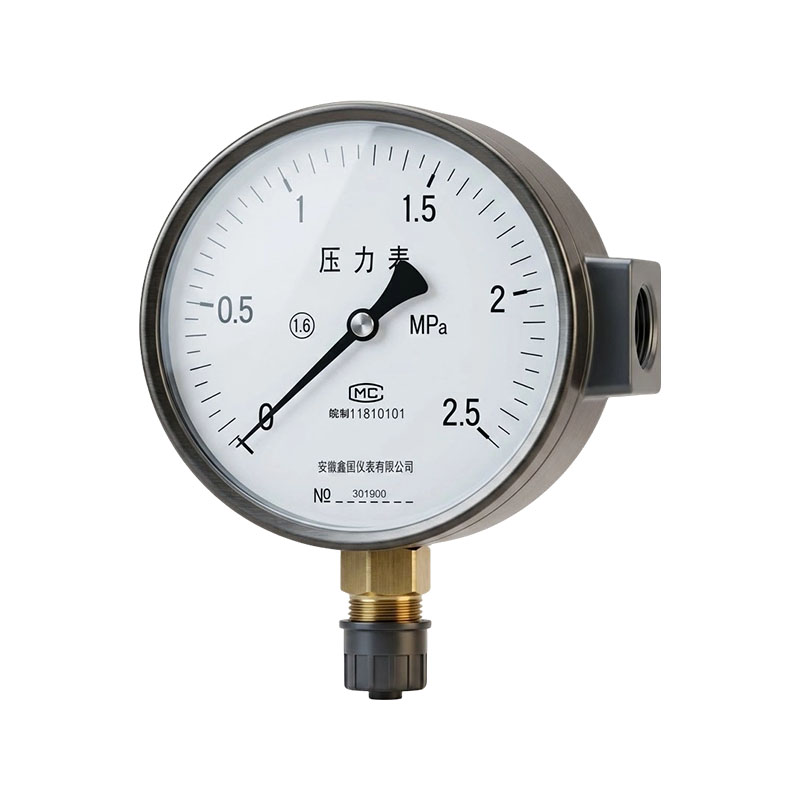
XG/YA -100 、 150 series ammonia pressure gauge
Ammonia is widely used because of its excellent thermodynamic properties and industrial value. It is an important refrigerant and a major raw material in fertilizer and chemical production. However, its compatibility requirements must be considered when selecting instruments, valves, fittings, seals, and other equipment that comes into contact with the medium.
A pressure gauge installed on an ammonia system is not simply a display device. It forms part of the equipment safety chain. Operators use the gauge to observe compressor discharge pressure, suction pressure, receiver pressure, pipeline pressure, or pressure changes during filling, operation, shutdown, and maintenance. If the instrument is damaged, inaccurate, or incorrectly selected, the operator may not recognize an abnormal process condition in time.
Standard pressure gauges often use copper alloys in their spring tubes, sockets, gears, or other wetted components. This construction can be appropriate for many general industrial media, but it is not the preferred choice for ammonia service. Ammonia exposure can cause corrosion of copper and copper alloys, especially when moisture, temperature variation, or other operating factors are present. A damaged spring tube or pressure connection can create a leakage path and a serious operating risk.
The XG-YA series is developed around the specific requirements of ammonia systems. Its measuring system excludes copper-alloy components and uses a stainless steel spring tube as the elastic pressure-sensing element. The application is also identified directly on the gauge so that technicians can distinguish it from a conventional pressure gauge during installation, inspection, replacement, and maintenance.
This application-specific approach offers two benefits. First, the material selection is aligned with the chemical characteristics of ammonia. Second, the visual identification reduces the possibility of installing a general-purpose copper-core gauge where an ammonia-compatible instrument is required.
The gauge can be used to measure both gaseous ammonia and liquid ammonia pressure when the selected range, connection, temperature, and installation conditions are suitable. Gas and liquid applications may behave differently, however. Liquid ammonia systems can experience substantial pressure changes during filling, evaporation, temperature variation, compressor cycling, or valve operation.
In these conditions, the pointer may be exposed to rapid movement or pressure pulsation. A shock-resistant oil-filled version can help damp mechanical movement, reduce pointer vibration, and make the displayed value easier to observe. It is particularly useful on ammonia compressors, refrigeration units, and storage equipment where pressure fluctuations are a normal part of operation.
Although modern plants may also use pressure transmitters and digital control systems, local mechanical indication remains valuable. A technician standing beside a compressor, receiver, pipeline, or tank can read the pressure without depending on a remote control system. Local gauges also provide a direct reference during commissioning, inspection, maintenance, and troubleshooting.
The 100 mm dial is suitable for many general installation points where space is limited or where a compact instrument is preferred. The 150 mm dial provides a larger viewing area and can be advantageous when the gauge is installed farther from the operator, at a higher elevation, or in a location where quick visual reading is important.
The XG-YA series operates according to the established elastic deformation principle used in mechanical spring-tube pressure gauges. When ammonia pressure enters the pressure connection, it acts on the stainless steel spring tube. The tube deforms by a small, controlled amount in response to the pressure. This movement is transmitted through a mechanical linkage and gear mechanism to the pointer, which moves across the dial.
The resulting display gives the operator a direct indication of pressure or pressure-vacuum conditions. Because the instrument does not require an external power supply for basic indication, it can continue to provide a local reading even when electrical control equipment is unavailable, provided the gauge remains within its specified operating conditions.
The stainless steel spring tube is the central pressure-sensing component. It provides the elastic response necessary for measurement while improving compatibility with ammonia compared with a copper-alloy spring tube. The use of stainless steel also supports the instrument’s structural integrity in industrial environments where moisture, temperature changes, and process contamination may be encountered.
Material compatibility is especially important because a pressure gauge is exposed to the process medium at its inlet and internal pressure-sensing element. Choosing an ammonia-specific construction reduces the possibility that the wetted components will be weakened by the medium during long-term service.
The movement mechanism amplifies the small deformation of the spring tube and converts it into pointer rotation. This arrangement is mechanically simple and familiar to maintenance personnel. It also allows the gauge to provide continuous indication without requiring electronic signal processing.
For accurate service, the gauge should be installed within the specified pressure range and should not be used continuously at or beyond its maximum scale value. Excessive pressure, repeated overload, strong vibration, or severe pulsation can affect the movement and shorten the service life of any mechanical gauge.
The series provides multiple pressure ranges to support different ammonia system requirements. Available ranges include low-pressure, medium-pressure, and higher-pressure options. Pressure-vacuum scales are also available for applications where the operating condition may move below atmospheric pressure.
Listed ranges include 0 to 0.16 MPa, 0 to 0.25 MPa, 0 to 0.4 MPa, 0 to 0.6 MPa, 0 to 1 MPa, 0 to 1.6 MPa, 0 to 2.5 MPa, 0 to 4 MPa, 0 to 6 MPa, 0 to 10 MPa, 0 to 16 MPa, 0 to 25 MPa, 0 to 40 MPa, and 0 to 60 MPa. Pressure-vacuum options include -0.1 to 0.06 MPa, -0.1 to 0.15 MPa, -0.1 to 0.3 MPa, -0.1 to 0 MPa, -0.1 to 0.9 MPa, and -0.1 to 1.5 MPa, as well as other listed combinations.
The appropriate range should be selected according to the normal working pressure, expected transient pressure, system design pressure, and required readability. A range that is too high may reduce reading resolution, while a range that is too low may expose the gauge to overload. A common engineering practice is to select a scale that places normal operating pressure within the central portion of the dial while allowing sufficient capacity for process fluctuations.
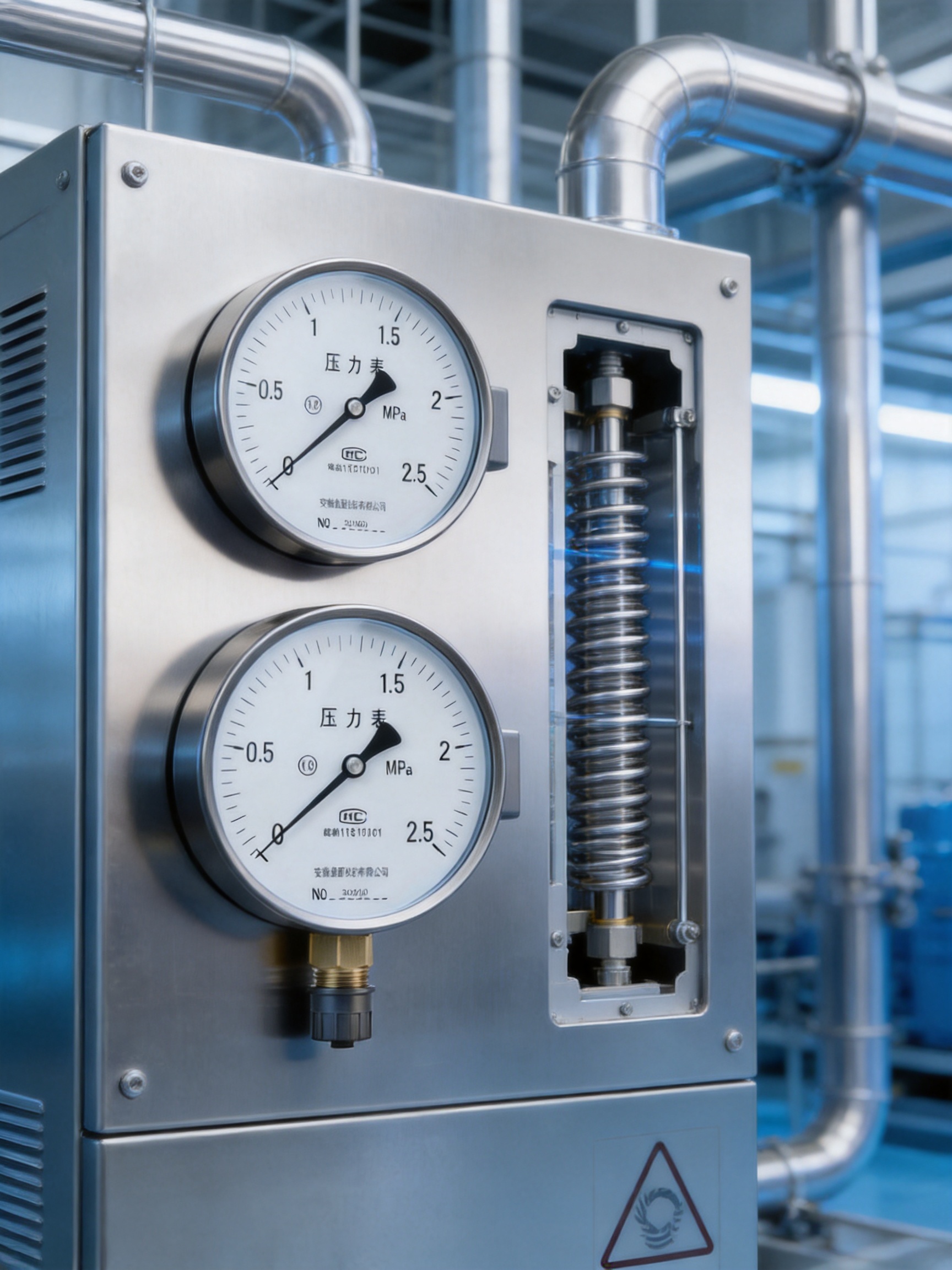
The most important advantage is the exclusion of copper-alloy components from the pressure measurement system. This construction is specifically intended to prevent ammonia-related corrosion of the spring tube and other pressure-containing parts.
A general-purpose gauge may be economical and suitable for air, water, oil, or other compatible media. It should not automatically be installed on an ammonia line. The problem is not only the initial material condition. Corrosion can progress gradually and may not be visible from the outside until the pressure boundary has already been weakened. A gauge specifically designed for ammonia reduces this material-selection risk at the equipment specification stage.
The gauge includes clear ammonia-specific warning identification on the dial or case. This marking is more than a visual design feature. In a busy plant, pressure gauges may be replaced by different technicians, contractors, or maintenance teams over many years. A clear application warning helps communicate that the instrument is intended for ammonia and should not be substituted with a standard copper-core gauge.
Dedicated identification also supports inventory control. Maintenance personnel can distinguish ammonia gauges from instruments intended for air, steam, water, oil, or other services. This can reduce the likelihood of incorrect installation during urgent repairs.
Ammonia compressors and refrigeration systems may produce pressure pulsations. Rapid pressure changes can cause the pointer of an ordinary mechanical gauge to oscillate, making the reading difficult to interpret. Continuous pointer movement may also accelerate wear in the movement mechanism.
The XG-YA series can be supplied in a shock-resistant oil-filled version. The filling fluid helps damp the movement of the pointer and reduces the effect of vibration and pulsation. This does not eliminate the need to select a correct pressure range or to control excessive pulsation, but it provides a practical improvement for demanding operating conditions.
Ammonia systems require careful attention to sealing. Leakage can affect equipment performance, create an unsafe working environment, and contribute to product loss or environmental release. The XG-YA series uses a strengthened sealing arrangement intended to limit medium penetration and leakage from the instrument assembly.
Correct installation remains essential. The gauge connection, gasket or sealing method, thread compatibility, tightening procedure, and pipe support must all be suitable for the application. A well-designed gauge cannot compensate for damaged threads, incorrect sealant, excessive tightening, or unsupported pipe loads.
The series uses a standard universal threaded interface for convenient installation and replacement. This helps maintenance personnel exchange an existing gauge without making major changes to the connection point, provided that the actual thread specification and mounting arrangement are verified before ordering.
The simple mechanical design also supports routine inspection. Technicians can check the case, dial, pointer movement, connection, seal, and visible signs of corrosion without specialized electronic diagnostic equipment. Where necessary, the gauge can be removed for calibration verification or replacement according to the plant’s maintenance program.
Dial diameter affects visibility and installation flexibility. The 100 mm model offers a compact solution for equipment panels and local connection points. The 150 mm model provides a larger display for locations where the operator must read the gauge from a greater distance.
Large, clearly arranged analog indication remains useful in industrial environments where operators wear protective equipment, where lighting varies, or where the gauge must be checked quickly during a round inspection. The choice between 100 mm and 150 mm should consider viewing distance, available space, mounting position, and the need for rapid abnormal-condition recognition.
The XG-YA-100 and XG-YA-150 series is offered with accuracy classes of 2.5 and 1.5, depending on the selected configuration. The accuracy class should be matched to the process requirement. A lower numerical accuracy class generally represents tighter allowable indication error, making the more accurate version preferable where process control or comparison with reference equipment requires improved precision.
The specified operating environmental temperature is -40 to 70 degrees Celsius, with relative humidity not exceeding 90 percent. These conditions make the instrument suitable for many indoor and outdoor industrial installations, provided that the actual environment does not include unaddressed chemical attack, extreme vibration, freezing contamination, or other conditions outside the product specification.
The temperature effect is listed as no more than 0.4 percent per 10 degrees Celsius when the operating temperature deviates from the reference condition of 20 plus or minus 5 degrees Celsius. Temperature should therefore be considered when the gauge is installed near hot compressor discharge lines, cold evaporator equipment, outdoor storage tanks, or locations with substantial seasonal variation.
The approximate weight is 0.6 kg for the YA-100 version and 0.9 kg for the YA-150 version. These weights should be considered when evaluating pipe support, panel mounting, and mechanical loading at the connection point.
| Product parameter | YA-100 | YA-150 |
| Nominal dial size | 100 mm | 150 mm |
| Accuracy class | 2.5 or 1.5 | 2.5 or 1.5 |
| Operating temperature | -40 to 70 degrees Celsius | -40 to 70 degrees Celsius |
| Relative humidity | Not more than 90 percent | Not more than 90 percent |
| Approximate weight | 0.6 kg | 0.9 kg |
| Pressure connection dimensions listed | D 100, H 87, L 20, S 17 | D 100, H 116, L 20, S 17 |
The dimensional information should be checked against the final drawing and ordered configuration before installation. Mounting orientation, connection position, thread specification, and any optional case or filling arrangement can affect the installation details.
Industrial refrigeration systems use ammonia in compressors, condensers, evaporators, receivers, separators, and associated pipelines. Pressure readings help operators assess the relationship between the high-pressure and low-pressure sides of the system, observe compressor performance, and identify unusual conditions during startup or shutdown.
A dedicated ammonia gauge is appropriate for local measurement at compressor skids, receiver vessels, suction headers, discharge lines, and service stations. For compressor locations with vibration and pulsation, the oil-filled shock-resistant version can improve readability and reduce pointer oscillation.
Storage tanks and receivers require dependable pressure monitoring during filling, storage, transfer, and isolation. Temperature changes can affect ammonia pressure, and pressure may change as the liquid level and vapor space vary. A local gauge gives operators a direct indication at the vessel or nearby process point.
The gauge should be installed with suitable isolation and protection arrangements where required by the system design. Isolation valves can assist with maintenance, while a suitable snubber or pulsation-reduction device may be considered if rapid pressure fluctuation is expected. The gauge should never be used as a substitute for a complete pressure relief and process safety system.
Ammonia is central to many fertilizer processes and is also used as a feedstock or process medium in chemical manufacturing. Pressure monitoring may be required on storage, transfer, vaporization, reaction, and distribution equipment.
In these environments, the compatibility of the pressure gauge is particularly important because the plant may contain multiple process media and many visually similar instruments. The ammonia warning marking helps technicians identify the correct instrument and reduces the risk of cross-application during maintenance.
Packaged systems and process skids often require compact local gauges at multiple points. The 100 mm version can be practical where instrument space is limited. The 150 mm version may be better where operators need to read the gauge from a walkway or across a larger equipment frame.
For skid builders and original equipment manufacturers, an ammonia-specific gauge can simplify equipment specification. It offers a consistent product category for different pressure ranges while retaining a familiar mechanical operating principle.

The product is manufactured by Xinguo Group Co., Ltd., an industrial enterprise with operations covering temperature instruments, pressure instruments, flow meters, level instruments, instrument materials, alloy wire, cables, and related products. The group was founded in 1997 and is based in Tianchang City, Anhui Province, China.
The company operates as a group consisting of Anhui Xinguo Instrument Co., Ltd., Shenyang Oudi Instrument Manufacturing Co., Ltd., Anhui Xinguo Alloy Co., Ltd., Anhui Xinguo Cable Co., Ltd., and Anhui Xinguo Precious Metal Co., Ltd. This structure provides access to capabilities in instrument manufacturing, alloy materials, cable production, and related industrial components.
The reported registered capital is RMB 118 million. The company covers more than 150 mu of land, has a construction area of approximately 60,000 square meters, and employs nearly 300 people. Its technical workforce includes more than 50 professional technicians, senior technical experts, senior engineers, engineers, and assistant engineers.
For an ammonia pressure gauge, material control begins before final assembly. The pressure-sensing element, pressure connection, movement components, seals, case, and dial must be considered as part of the complete application. The central design principle is that copper-alloy components should not be used in the ammonia pressure measurement system.
Application-specific product design allows the manufacturer to establish a defined material and construction route rather than adapting a general-purpose gauge after production. This supports more consistent product identification, purchasing, inspection, and maintenance.
The group maintains research and development capabilities supported by professional technical personnel, modern equipment, and production experience in multiple industrial instrument categories. This technical foundation is valuable because pressure gauges are not isolated products. Their performance depends on material selection, spring-tube forming, mechanical movement design, sealing, calibration, case construction, and environmental protection.
Experience across temperature, pressure, alloy, and cable products also supports a broader understanding of industrial measurement applications. Customers can therefore work with a manufacturer that supplies several classes of industrial instruments and materials rather than relying only on a narrow single-product production line.
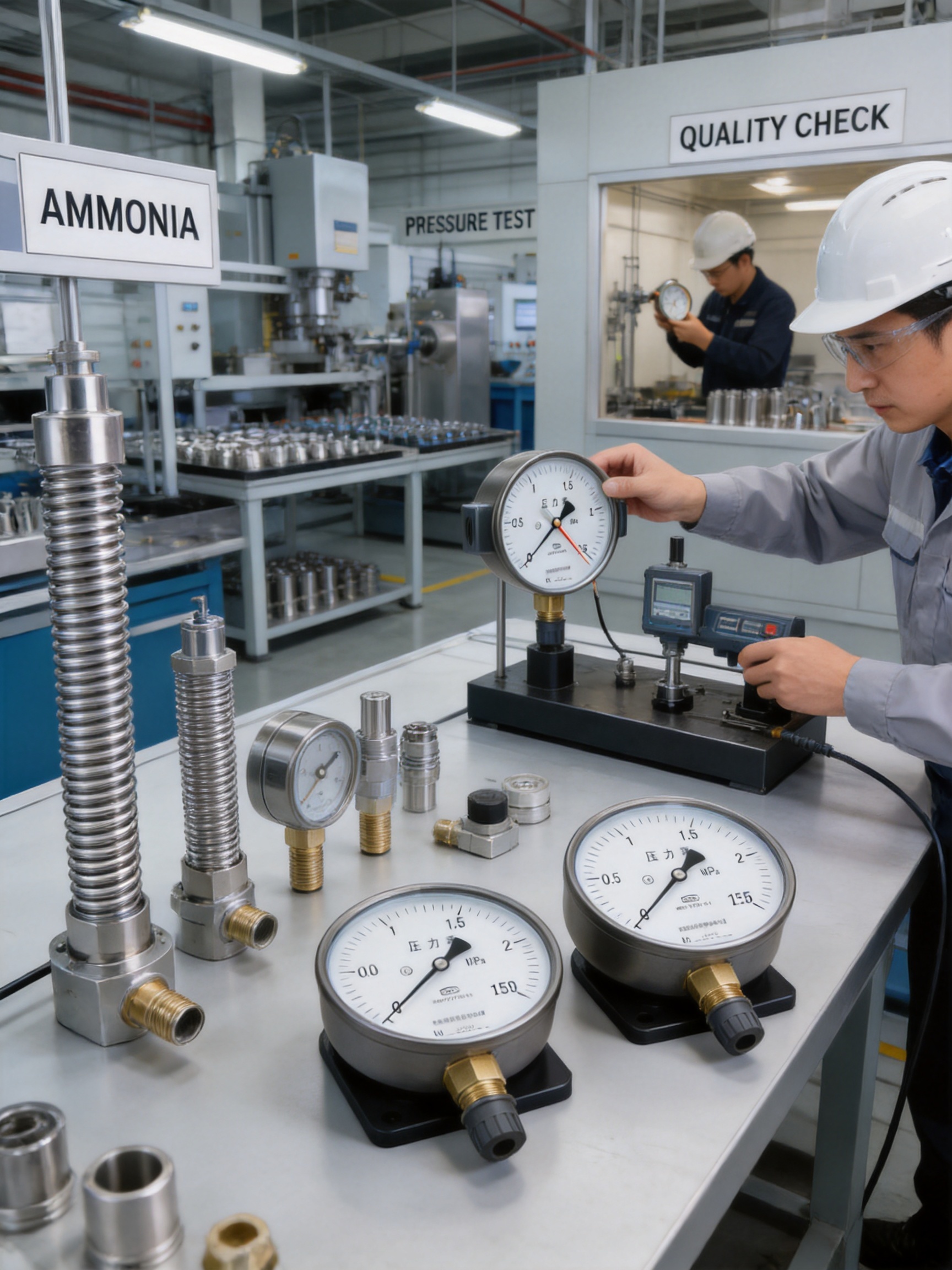
The company reports the use of advanced equipment, modern production techniques, and inspection procedures at each stage of manufacturing. For a mechanical pressure gauge, production quality depends on repeatability in forming the spring tube, assembling the movement, setting the pointer, installing the dial and case, controlling sealing, and verifying indication performance.
Inspection should address both the finished instrument and the components used to build it. Typical quality activities for this product category include visual inspection, dimensional verification, pressure testing, indication testing, leak inspection, movement checks, and review of material and configuration requirements. The exact inspection plan depends on the selected model, accuracy class, pressure range, and customer requirements.
Xinguo Group has obtained ISO 9001 Quality Management System, ISO 14001 Environmental Management System, and GB/T 28001 Occupational Health and Safety Management System certifications, according to the supplied company information. These systems reflect a structured approach to quality management, environmental responsibility, and workplace safety.
For international customers, a documented management system can support supplier evaluation, production traceability, corrective action, and communication between technical, manufacturing, inspection, and export departments. Certification alone does not replace product-specific verification, but it provides an organized framework for maintaining consistent business and manufacturing processes.
The company states that its products comply with IEC international standards as well as applicable national and industrial specifications. Customers should confirm the exact standards, certificates, test documents, and conformity requirements applicable to their specific order and destination market.
For ammonia pressure gauge projects, technical communication should cover the pressure range, accuracy class, dial size, connection thread, mounting orientation, operating temperature, pulsation level, filling option, and any required documentation. Clear specification at the quotation stage reduces the possibility of receiving a technically unsuitable configuration.
The selected gauge range should reflect both normal operating pressure and expected transient conditions. A gauge should not operate continuously at the extreme end of its scale. If the process has significant pressure surges, the range and optional damping arrangement should be selected accordingly.
For pressure-vacuum applications, confirm that the system can actually fall below atmospheric pressure and select a scale that gives adequate resolution on both the vacuum and positive-pressure portions. The scale should also match the units required by the operating team and project documentation.
Although the series uses a standard universal threaded interface, the actual connection must be verified before installation. Confirm the thread type, nominal size, mounting direction, connection length, and sealing method. Do not force a gauge into a mismatched thread, and do not use excessive torque to compensate for an incorrect fitting.
Where a sealant is used, it must be compatible with ammonia service and applied so that excess material cannot enter the pressure passage. The connection should be supported independently where pipe vibration or mechanical loading could be transmitted to the gauge.
High or low temperature can affect indication and materials. If the gauge is exposed to a process temperature outside the normal ambient range, the installation may require a suitable impulse line, cooling arrangement, protective device, or other engineering measure. The specified temperature effect should be considered when accurate readings are important.
For compressors, pumps, rapidly cycling valves, and other pulsating systems, consider the oil-filled shock-resistant configuration. A pressure snubber, restrictor, or suitable isolation arrangement may also be used where allowed by the process design. These devices must be selected carefully so that they do not create unacceptable response delay or become blocked by contaminants.
The gauge should be positioned where operators can read it without entering an unsafe area or reaching across hot, moving, or pressurized equipment. The dial should face the normal inspection route, and lighting should be adequate. The 150 mm model may be preferred when the reading distance is large.
Where the gauge is installed outdoors, protection from direct mechanical impact, standing water, severe contamination, and unauthorized adjustment should be considered. The instrument should remain accessible for inspection but protected from avoidable damage.
Before placing the instrument into service, inspect the case, lens, dial, pointer, connection, and warning markings. Confirm that the pressure range and application are correct. Check that the pointer returns to a reasonable zero position when the gauge is isolated and depressurized, taking account of the specific product configuration.
During commissioning, gradually introduce pressure and observe the pointer. Sudden pointer sticking, excessive oscillation, leakage, or abnormal noise should be investigated before continuing operation. The gauge should not be exposed to pressure beyond its rated scale or to a medium for which it was not designed.
Routine inspection is important even when the gauge appears to be operating normally. Operators should look for fogging, case damage, cracked glass, pointer instability, corrosion, leakage, blocked connections, and changes in reading compared with related instruments.
A pointer that jumps or a reading that appears inaccurate may have several causes. Large pressure pulsation can make the pointer unstable. Excessive temperature can affect the indication. Internal corrosion, contamination, mechanical wear, or an over-range event can also cause abnormal behavior.
If the gauge is installed in a pulsating application, an oil-filled version should be considered. If the gauge has been exposed to overpressure, impact, freezing, or suspected corrosion, it should be removed from service and assessed rather than returned to operation without inspection.
Calibration verification should follow the user’s quality system, process criticality, regulatory requirements, and manufacturer recommendations. Critical applications may require more frequent verification than general local indication points. Calibration should be performed using suitable reference equipment and procedures.
When leakage or visible corrosion is found, the gauge should be isolated and replaced or repaired according to the site safety procedure. Do not attempt to open or modify a pressurized gauge. Ammonia service requires trained personnel, appropriate personal protective equipment, ventilation, and a controlled isolation procedure.
| Selection consideration | General-purpose copper-core gauge | XG-YA ammonia pressure gauge |
| Primary application | Compatible general industrial media | Ammonia and liquid ammonia systems |
| Pressure-sensing material | May include copper alloy | Stainless steel spring tube |
| Ammonia compatibility | Must be specifically verified and is often unsuitable | Designed specifically for ammonia service |
| Application identification | Usually general-purpose marking | Dedicated ammonia warning identification |
| Pulsation option | Depends on product design | Shock-resistant oil-filled version available |
| Pressure-vacuum ranges | Depends on model | Multiple listed pressure-vacuum options |
| Dial sizes | Depends on model | 100 mm and 150 mm versions |
| Sealing approach | Depends on product and medium | Strengthened sealing structure for ammonia service |
The comparison shows why an ammonia-specific gauge should be treated as a safety-related selection rather than a simple interchangeable commodity. A lower purchase price for a general-purpose gauge may not represent a lower total cost if corrosion, inaccurate indication, leakage, unplanned replacement, or safety risk results from incorrect material selection.
Ammonia can corrode copper and copper alloys under suitable service conditions. Corrosion may weaken the spring tube or other pressure-containing components, leading to inaccurate readings, leakage, or instrument failure. The XG-YA series uses a stainless steel spring tube and prohibits copper-alloy components in the measuring system for ammonia applications.
Yes. The gauge can be applied to gaseous ammonia and liquid ammonia when the selected model, range, connection, temperature, and installation conditions are appropriate. Liquid ammonia systems may experience stronger pressure variation, so an oil-filled shock-resistant version is recommended where pulsation or vibration is significant.
No. The product is specially designed for ammonia and liquid ammonia service. It should not be assumed to be suitable for every strongly corrosive medium. The compatibility of the pressure-sensing element, connection, seals, and other wetted components must be checked for the actual process fluid. A diaphragm-type corrosion-resistant pressure gauge may be more appropriate for some other media.
Common causes include pressure pulsation, vibration, excessive temperature, an unsuitable pressure range, blocked or restricted connections, internal corrosion, mechanical wear, or previous overpressure. An oil-filled shock-resistant gauge can help with vibration and pulsation. The installation should also be checked, and the gauge should be replaced if corrosion, leakage, or mechanical damage is found.
Select a range that includes the normal operating pressure and allows sufficient capacity for expected fluctuations. Avoid selecting a range so high that normal pressure is difficult to read accurately, and avoid selecting a range so low that routine fluctuations create overload. The process design pressure and possible transient conditions should also be considered.
The 100 mm model is suitable when installation space is limited or when the gauge will be read from a relatively short distance. It can be used on many equipment connection points, compact refrigeration skids, and local panels, subject to the required pressure range and connection details.
The 150 mm model provides a larger viewing area and may be preferable when the gauge is mounted farther from the operator, positioned at a higher level, or used during frequent inspection rounds. The final choice should also consider available mounting space and the weight of the instrument.
The listed operating temperature range is -40 to 70 degrees Celsius with relative humidity not exceeding 90 percent. Outdoor use may be possible when the actual environment remains within the product specification and the gauge is protected from impact, water accumulation, severe contamination, and unsuitable chemical exposure. Installation conditions should be reviewed before ordering.
No. Oil filling can damp pointer movement and reduce the effects of pulsation, but it does not eliminate inspection, calibration verification, or replacement requirements. The gauge should still be checked for leakage, case damage, pointer behavior, corrosion, and correct pressure indication.
Provide the required model or dial size, pressure or pressure-vacuum range, accuracy class, connection thread, mounting orientation, operating temperature, ammonia state, expected pulsation or vibration, oil-filled requirement, quantity, and documentation requirements. This information allows the manufacturer to confirm the appropriate configuration.
Choosing an ammonia gauge is closely connected with choosing a manufacturer that understands industrial instrumentation. The product must be more than a pressure display with a different dial label. It requires appropriate material control, consistent mechanical assembly, reliable sealing, correct calibration, and clear application identification.
Xinguo Group’s broader product portfolio includes temperature instruments, thermocouples, pressure instruments, flow meters, level instruments, instrument materials, alloy wire, pressure transmitters, and pressure gauges. This portfolio demonstrates experience in several key areas of industrial measurement and materials engineering.
The company’s research and development personnel, production facilities, inspection procedures, and management systems provide a foundation for manufacturing products for domestic and international markets. Its stated focus on customer service, consistent quality, technical innovation, compliance, and continuous improvement supports long-term cooperation with equipment manufacturers, system integrators, distributors, and end users.
For customers purchasing ammonia pressure gauges in volume, manufacturing strength also affects supply consistency. Stable production processes can help maintain model continuity, replacement availability, configuration control, and technical support over the operating life of refrigeration or chemical equipment.
The ability to discuss the gauge together with other instrumentation can also simplify project coordination. Customers may require temperature measurement, pressure transmitters, flow measurement, level instruments, cables, or alloy materials in the same project. A manufacturer with a broad technical range may help reduce communication interfaces and improve consistency across the instrument package.
The XG-YA-100 and XG-YA-150 series ammonia pressure gauges are designed for a specific and important industrial requirement: safe, dependable local pressure indication in ammonia and liquid ammonia systems. Their principal advantage is the use of a stainless steel spring tube and the prohibition of copper-alloy components in the pressure measurement system. This construction addresses the corrosion risk associated with using ordinary copper-core gauges in ammonia service.
The series also provides dedicated ammonia identification, reinforced sealing, standard threaded installation, multiple pressure and pressure-vacuum ranges, two dial sizes, and an optional oil-filled shock-resistant configuration. These features make the gauges suitable for ammonia refrigeration systems, compressors, storage tanks, fertilizer plants, chemical equipment, and process pipelines.
Product performance depends on correct selection and installation. Users should confirm the pressure range, accuracy class, connection, environmental conditions, pulsation level, and compatibility with the actual process. Regular inspection and calibration verification remain necessary, particularly in safety-critical applications.
Supported by a manufacturer with extensive industrial instrumentation experience, research and development resources, modern production equipment, documented management systems, and broad product capabilities, the series offers a practical alternative to general-purpose pressure gauges. For ammonia applications, selecting a purpose-built instrument is an essential step toward reducing material compatibility risks, improving maintenance identification, and supporting reliable plant operation.
1. Product technical information for the XG-YA-100 and XG-YA-150 series ammonia pressure gauges.
2. Manufacturer-provided specifications for pressure ranges, accuracy classes, environmental conditions, temperature effect, dimensions, and weights.
3. Manufacturer-provided company information concerning research and development, production facilities, quality management systems, and industrial instrumentation capabilities.
4. General engineering principles for elastic spring-tube pressure measurement.
5. General industrial guidance for ammonia-compatible materials, pressure gauge installation, pulsation control, inspection, and maintenance.
6. General quality management principles associated with ISO 9001, environmental management principles associated with ISO 14001, and occupational health and safety management principles associated with GB/T 28001.



 INQUIRY
 English
 عربى
 русский
 中文简体